
Remote Video Monitoring for Parking Lots & Garages in Ontario
September 22, 2026
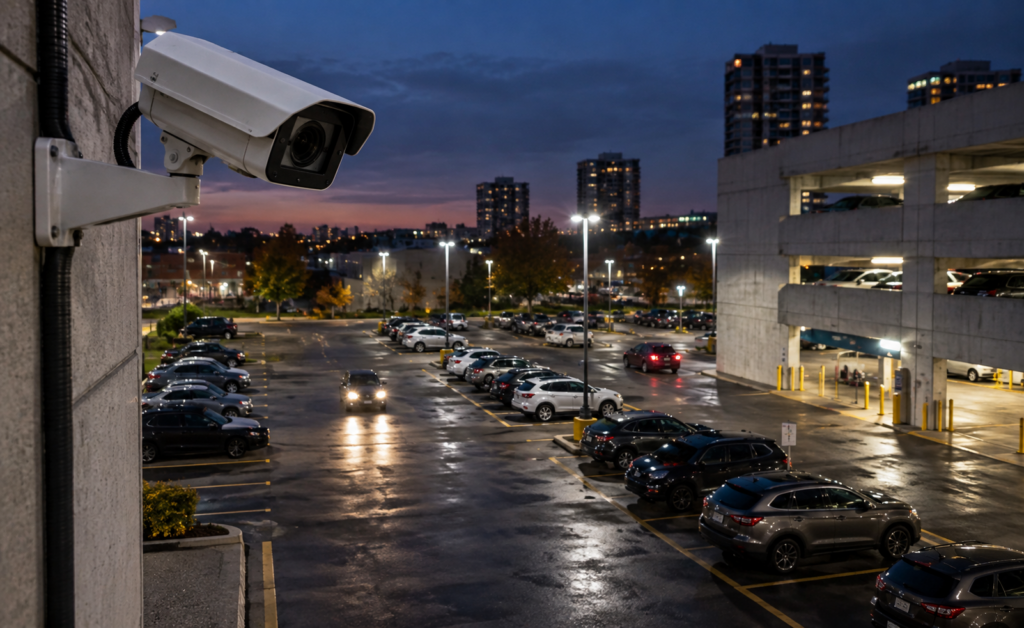
Parking lots and parking garages are common security problem areas because they combine vehicles, pedestrian movement, multiple access points, blind spots and periods of low activity. Traditional CCTV can record what happened, but active remote video monitoring can add live operator review and a defined response process while an event is occurring.
Remote video monitoring can help protect parking lots and garages by combining security cameras, event detection, live operator verification, audio intervention where available, and escalation to onsite staff or mobile patrol when required. The strongest programs are designed around the property’s actual traffic patterns, risk areas and operating hours.
This guide explains where remote monitoring fits, how camera placement should be planned, when existing cameras can be reused, and how parking enforcement and patrol services can work alongside video monitoring.
Quick Answer: What Areas Should Be Monitored?
The most important parking areas usually include:
- vehicle entrances and exits;
- parking garage ramps;
- pedestrian doors and elevator lobbies;
- visitor parking areas;
- loading zones;
- bike storage entrances;
- payment or access-control points;
- garage levels with poor natural visibility;
- surface-lot perimeters; and
- areas with repeated trespassing, loitering or vehicle-related incidents.
The objective is not simply to install more cameras. It is to ensure the operator can see the sequence of events clearly enough to make a useful decision.
Why Parking Areas Are Well Suited to Remote Monitoring
Parking areas often have predictable periods of legitimate activity. At a condominium, traffic may be highest during morning and evening commuting periods. At a commercial site, activity may drop sharply after the business closes. At an industrial facility, only approved employee or delivery vehicles may be expected overnight.
These patterns can help define monitoring rules around specific zones and hours.
Remote monitoring may be useful for identifying activity such as:
- people checking vehicle doors;
- unauthorized access through garage entrances;
- tailgating behind an authorized vehicle;
- loitering in restricted areas;
- vehicles remaining onsite after hours;
- people moving between parked vehicles without an obvious purpose;
- entry into closed loading or service areas; and
- repeated activity around doors, gates or storage areas.
Parking Lot Security Cameras Need the Right Views
Search demand for parking lot security cameras is strong because camera placement directly affects whether a security system is useful.
A good parking camera plan should provide enough context to understand:
- how a vehicle entered;
- where a person came from;
- which direction they travelled;
- whether they interacted with vehicles or doors;
- whether another person or vehicle was involved; and
- how they left the area.
Wide overview cameras are useful, but they may need to be supplemented with tighter views at gates, ramps and pedestrian doors.
Parking Garage Security Requires Different Camera Planning
Underground garages create additional challenges because of columns, ramps, changing light conditions and blind corners.
Camera planning should consider:
- garage entrance and exit lanes;
- pedestrian doors;
- elevator lobbies;
- stairwell access;
- turning points between levels;
- areas behind structural columns;
- bike and storage rooms; and
- connections between the garage and residential or commercial areas.
Night performance is less relevant underground than in an outdoor lot, but consistent lighting, image clarity and blind-spot control remain critical.
How the Remote Monitoring Workflow Works
A typical event follows a defined sequence:
- Detection: a camera or analytics rule identifies activity in a monitored zone.
- Verification: a live operator checks the relevant camera and surrounding views.
- Intervention: if speakers are installed and the procedure allows it, the operator may issue a live warning.
- Escalation: the operator follows the site’s approved response plan.
- Documentation: the event and response are recorded for follow-up.
For the complete response process, see What Happens When a Remote Security Operator Detects an Intruder?.
Can Existing Parking Cameras Be Used?
Often, yes. Existing parking cameras may be suitable if they provide clear video, stable connectivity, appropriate coverage and compatibility with the monitoring platform.
A readiness assessment should review:
- camera make and model;
- NVR or video management system;
- image quality;
- field of view;
- lighting conditions;
- remote access;
- network reliability;
- analytics capability; and
- speaker integration.
For a detailed technical checklist, read Can Existing CCTV Cameras Be Used for Remote Video Monitoring?.
Remote Monitoring vs. Recording-Only CCTV
Traditional CCTV is valuable for investigations, but it often relies on someone reviewing footage after an event. Remote video monitoring adds an active response layer.
| Recording-Only CCTV | Remote Video Monitoring |
|---|---|
| Records footage | Adds live event review |
| Often reviewed later | Can support action while activity is occurring |
| No operator intervention by default | Can support talk-down and escalation |
| Useful for evidence | Useful for intervention and evidence |
See Live Video Monitoring vs. Traditional CCTV for a full comparison.
Audio Talk-Down in Parking Areas
Talk-down speakers can add a deterrence and intervention layer when the monitored area is suitable for audio.
For example, an operator may warn a person that the property is under live monitoring and instruct them to leave a restricted parking area.
Speaker placement should be designed around the actual camera zones. A speaker mounted too far from the activity may not be effective.
Parking Enforcement and Security Monitoring Are Different
Parking enforcement focuses on parking rules, permits, visitor authorization, unauthorized vehicles and related property policies. Remote video monitoring focuses on security events and live observation.
The two services can complement one another.
For example:
- parking enforcement can address unauthorized vehicles;
- remote monitoring can detect suspicious pedestrian or vehicle activity;
- mobile patrol can physically attend the site; and
- incident reporting can give management a record of recurring problems.
Learn more about our Parking Enforcement Services.
When Mobile Patrol Should Be Included
Remote operators can verify activity, but some situations still require physical attendance.
Mobile patrol can be used as part of the escalation plan where the client wants a physical response option without maintaining a guard onsite continuously.
This can be especially useful for:
- surface parking lots;
- commercial plazas;
- office properties;
- condominiums;
- industrial yards; and
- multi-building properties.
When an Onsite Guard Still Makes Sense
Some parking areas require onsite staff because the security role includes responsibilities beyond camera observation.
A guard may still be appropriate when the site requires:
- gatehouse duties;
- resident or tenant assistance;
- vehicle access control;
- physical patrols;
- key control;
- contractor access; or
- frequent physical interaction with drivers and pedestrians.
Remote monitoring may still support the guard by extending visibility to areas that are difficult to patrol continuously.
See Remote Video Monitoring vs. Security Guards.
Condominium Parking Garages
Condominium garages often connect directly to residential areas, making unauthorized garage access a broader building-security issue.
Important zones may include:
- garage doors and ramps;
- resident access doors;
- visitor parking;
- elevator lobbies;
- bike storage;
- parcel or service areas; and
- secondary entrances.
For a broader residential strategy, see Remote Video Monitoring for Condominiums in Ontario and our Condo Security Checklist.
Commercial Parking Lots
Commercial lots may be mostly empty after business hours, making unusual activity easier to identify.
Remote monitoring can be configured around:
- vehicle entrances;
- building entrances;
- loading zones;
- employee parking;
- service areas;
- dumpsters; and
- perimeter approaches.
See Remote Video Monitoring for Commercial & Industrial Properties in Ontario for a broader commercial strategy.
Construction and Temporary Parking Areas
Construction projects may have temporary parking areas, contractor vehicle zones and access routes that change as the project progresses.
Camera placement should therefore be reviewed as fencing, gates and work zones change.
See Remote Video Monitoring for Construction Sites in Ontario.
What Should a Parking Security Assessment Review?
A practical assessment should answer:
- Which parking areas have the highest incident risk?
- Where do vehicles enter and leave?
- Where do pedestrians enter the building?
- Are there blind spots?
- Is lighting adequate?
- Are existing cameras usable?
- Which zones require live monitoring?
- When is the property most vulnerable?
- Should talk-down speakers be added?
- Is mobile patrol required?
- How does parking enforcement fit into the plan?
- Who should be contacted after a verified event?
Frequently Asked Questions
Can remote video monitoring help deter vehicle break-ins?
It can support live detection and intervention where cameras provide suitable coverage and the event falls within the monitoring rules. No security system can guarantee that a crime will not occur.
Can the operator monitor license plates?
Depending on camera placement and image quality, vehicle information may be visible. Dedicated license-plate capture requires appropriate camera design and positioning.
Can existing garage cameras be reused?
Often, yes, if they provide suitable video quality, coverage and connectivity. A technical assessment is recommended.
Can remote monitoring work with parking enforcement?
Yes. Parking enforcement handles property parking rules, while remote monitoring handles security observation and event response. They can be used together as part of one property-security program.
Can mobile patrol be dispatched after a verified event?
Yes, where patrol dispatch is included in the service plan and the escalation procedure authorizes it.
Does every parking camera need to be monitored?
No. Monitoring should prioritize the cameras and zones that matter most to the site’s security objectives.
Build a Parking Lot or Garage Security Plan
Parking security is strongest when camera coverage, live monitoring, parking enforcement, patrol response and access control are designed as one coordinated program.
Identigate Security Services provides remote video monitoring, CCTV, parking enforcement, mobile patrol, guards and integrated security services across Ontario.
Request a parking lot or garage security assessment and proposal.
Explore More Security Resources
Review Identigate’s security services, systems, industry solutions and service areas for Toronto, the GTA and Ontario.
Need a Site-Specific Security Program?
Tell us about the property, operating environment and security requirements. Identigate can review the scope and recommend an appropriate combination of personnel, patrol, monitoring and technology.